
 United States
 Canada
 United Kingdom
 Germany
 Netherlands
 India
India Singapore
 Hong Kong
Britain’s leading consumer champion calls for a more realistic official test procedure, which shows both summer and winter ranges
Official testing of electric car ranges is completely unrepresentative of real-world conditions, potentially leaving drivers disappointed and with insufficient mileage, according to the latest research by What Car?, Britain’s leading consumer champion and new car deals platform.
The official Worldwide Harmonised Light Vehicle Test Procedure (WLTP), which is used to measure range, was found to be particularly unrealistic in cold conditions, where the shortfall reached almost 40% for some cars.
Comparing a selection of 12 new fully electric vehicles (EVs), the latest What Car? winter range test found that none of the cars could get within 20% of the official figures, which manufacturers are legally required to publish.
This is because the official tests subject EVs to unrealistically gentle acceleration and are conducted in a laboratory at an ambient temperature of 23deg C, instead of at colder temperatures where batteries are less efficient. Indeed, What Car?’s real-world testing shows an average drop in range of 18% in winter versus summer conditions.
What Car? is calling for a more balanced, holistic testing regime which provides drivers with realistic range estimates for both summer and winter conditions, to ensure buyers aren’t left disappointed and put off electric cars. However, in the absence of this, the What Car? Real Range testing provides drivers with figures that are in line with what they can expect to achieve on the road.
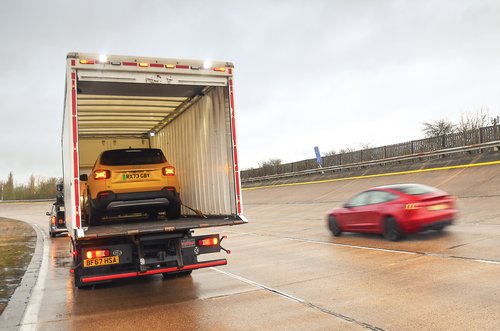
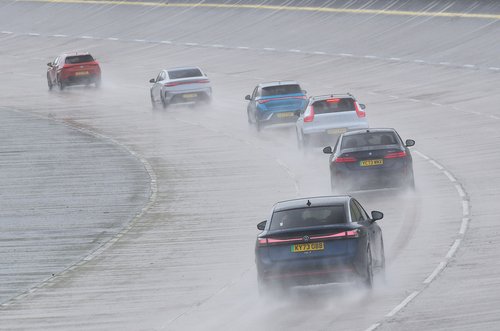
To find out how far the 12 EVs could really go on a full charge in winter, What Car? took them to a private test centre and drove them until their batteries were flat.
The 12 cars were charged to 100%, before being left out in the open overnight, for roughly 14 hours in 6-10deg C ambient conditions. Then the following morning they were plugged in again to check they were still fully charged, plus their tyre pressures were checked to ensure these were at the recommended levels, the climate control systems were set to 21deg C and the headlights were switched to dipped beam.
Eco (or the closest equivalent) driving mode was selected, and the cars were left in their default regenerative braking setting – or if an ‘automatic’ or ‘adaptive’ mode was available, this was selected.
For the tests themselves, the What Car? test team followed a route of roughly 15 miles, which included 2.6 miles of simulated stop-start urban driving, four miles at a steady 50mph and eight miles at a constant 70mph. At the end of each loop, there was a driver swap and a change in running order so that no car was at a disadvantage.
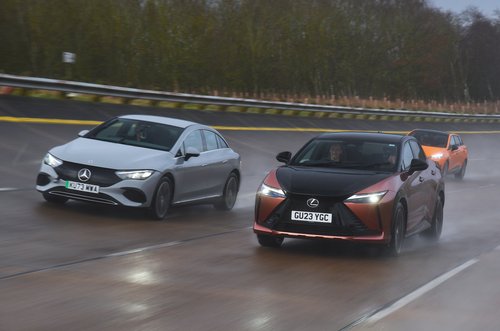
Two of the EVs tested got very close to, or reached, 300 miles on a full charge: the Mercedes-Benz EQE 300 Sport Edition managed exactly 300 miles, while the Tesla Model 3 Long Range achieved 293 miles. In addition, the EQE got closest to its official range (it fell 21% short).
By contrast, the driving conditions (10-11deg C) proved most challenging for the two Lexus models tested, with the RZ 450e Takumi falling 36.7% short of its official range, and the UX 300e Takumi down by 37.9%.
What Car? editor Steve Huntingford, said: “It is clear that the results obtained using WLTP methods are unsuitable. We need a new system that provides achievable summer and winter figures so that prospective EV buyers can be confident the car they’re looking at will suit their needs. Providing a single, overly optimistic figure doesn’t help anyone.”
For more information or additional commentary, please use the details below, and to read the full story, CLICK HERE.
WINTER RANGE TEST 2024: CRUNCHING THE NUMBERS
Tested cars ranked from smallest to biggest shortall in real-world test range
| Make and model | Price | Official range | Test Range | Shortfall |
| Mercedes-Benz EQE 300 Sport Edition | £68,810 | 380 miles | 300 miles | 21.0% |
| Tesla Model 3 Long Range | £49,990 | 390 miles | 293 miles | 24.8% |
| BMW i5 eDrive40 M Sport Pro | £77,105 | 338 miles | 253 miles | 25.1% |
| BYD Seal Design | £45,695 | 354 miles | 255 miles | 28.0% |
| BYD Dolphin Design | £31,695 | 265 miles | 188 miles | 29.1% |
| Volkwagen ID 7 Pro Match (with heat pump) | £52,600 | 381 miles | 268 miles | 29.6% |
| MG 4 Extended Range Trophy | £36,495 | 323 miles | 227 miles | 29.7% |
| Volvo XC40 Recharge Twin Motor Plus | £55,527 | 331 miles | 252 miles | 29.9% |
| Jeep Avenger Electric Summit | £38,700 | 244 miles | 163 miles | 33.1% |
| Volkwagen ID 7 Pro Match (without heat pump) | £51,550 | 383 miles | 254 miles | 33.6% |
| Lexus RZ 450e Takumi | £74,000 | 251 miles | 159 miles | 36.7% |
| Lexus UX 300e Takumi | £57,095 | 273 miles | 170 miles | 37.9% |


[ENDS]
Notes to Editors
About Haymarket Group
Haymarket Media Group is a privately-owned media, data and information company, shaping a better future with remarkable content for specialist audiences across the world. The company has 1,300 employees across offices in the UK, US, Canada, Hong Kong, Singapore, India and Germany.
Haymarket’s portfolio consists of more than 70 market-leading brands including Campaign, Third Sector, What Car?, MyCME and Asian Investor.
Through live, digital, print, education, data, tech services, video and audio, Haymarket’s brands inspire, inform and empower clients and communities internationally.
Media Enquiries: Tara Geoghegan, Communications & Impact Manager, Haymarket Media Group, [email protected]